Commercial

Food & Beverage Industry

HydroFLOW protects against limescale, reduces biofilm and bacterial contamination, and dramatically cuts effluent volume at food and beverage plants — for direct operating-cost savings and food-safety compliance.

Protection from limescale & biofilm Reduced wastewater volume Supports food safety
Operational and regulatory challenges

Quality production starts with quality water

Food plants, abattoirs, dairies and breweries are huge water and energy consumers, supervised under strict Ministry of Health regulation.

01

Microbial contamination and biofilm risk

Hot-water pipework and production lines tend to develop biofilm — fertile ground for dangerous bacteria like Listeria, Salmonella and coliforms.

✓ With HydroFLOWReducing biofilm and bacteria with no chemical residue in the product.
02

Heavy limescale in steam and sterilisation

In steam boilers, ovens and pasteurisation systems, hard limescale settles quickly and impairs heat transfer — driving up energy consumption.

✓ With HydroFLOWReduced limescale — fewer line shutdowns for chemical cleaning.
03

Water costs and fines for out-of-spec discharge

Israel’s industrial water tariff is roughly NIS 11.5–14 per cubic metre, plus sewage fees of NIS 5–7 per cubic metre — with exposure to fines for out-of-spec industrial discharge.

✓ With HydroFLOWLess wash water, lower risk of discharge violations.
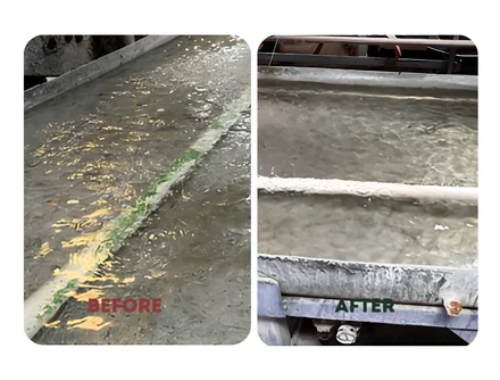
Food production line before and after HydroFLOW installation
Efficient, economical operation
HydroFLOW systems contribute to efficient, cost-effective operations
Want proof first? See our installation results and case studies →
The solution

How does HydroFLOW protect the food plant?

A unique, chemical-free technology, specially suited to the strict requirements of the food and beverage industry. The system is installed externally on existing pipework, with no modifications or shutdowns.

Biofilm disruption
Less cover for bacteria

Surfaces cleaner of limescale and biofilm let existing disinfectants act more effectively on the bacteria themselves.

Less energy
Savings on hot-water systems

Keeping hot-water systems efficient across a range of food-plant types — less limescale, less energy for the same output.

Equipment protection
Less limescale in taps and spray nozzles

Keeping spray nozzles, valves and pipework free of limescale — fewer blockages and fewer line stoppages.

None
Changes to the production line

Easy installation with no changes to the existing system.

Installation process

Three steps to an advanced solution.

01

Installation

The HydroFLOW system is installed externally onto the plant’s water pipework, with no cutting or production-line shutdown.

02

Treatment

A unique electrical signal operates along the pipework, continuously, 24 hours a day.

03

Result

Less biofilm and bacteria, less limescale in steam boilers and less effluent to drain.

A common issue on food production lines

Spray nozzles — the first point to clog

Every evaporated droplet leaves minerals at the line’s narrowest opening

Spray nozzles, injectors and bottle-washing machines are usually the first component to clog on a production line — because with every evaporation cycle, dissolved minerals stay concentrated exactly at the narrowest opening they passed through. Every such blockage stops the line and requires an acid dip.

Case study: at a UK snack manufacturer, 200-micron spray nozzles went from a weekly acid dip to 24 weeks with no blockage — saving roughly 147 production hours a year.

Read the full case study →
The industrial context

Cleaning, not the product itself, is the biggest water consumer

In the food and beverage industry, most water never becomes the product — it goes to cleaning. That’s exactly where HydroFLOW comes in: fewer cleaning cycles are needed, since the pipework stays cleaner to begin with.

4–10 litres
of water per litre of beer produced — most for cleaning, not the beer itself
~70%
of a dairy plant’s water use goes to cleaning and CIP
1.2–3.4 litres
of water per litre of milk processed — intake, pasteurisation, cooling and cleaning

The direct connection: at Tims Dairy in the UK, HydroFLOW treatment reduced milk-line cleaning frequency from twice a week to once a week. Because cleaning is such a dominant share of a food plant’s water use, any reduction in cleaning frequency translates directly into water savings — not just chemical savings.

Industry statistics sources: Grundfos; Singh et al. (2024), Water Footprints of Dairy Milk Processing Industry, Water 16(3):435 — general global data, not Israel-specific.
Important to word precisely: HydroFLOW is not a disinfectant and does not make water potable. It does not replace CIP chemistry, disinfectant dosing, or food-safety obligations (HACCP) — it treats the limescale and biofilm that make all of those work harder than they should.
Case studies

Documented results from the food and beverage industry

50% less acid
Milk-line cleaning from twice a week to once — Tims Dairy, UK.
Case study →
20% faster
Steam rises faster, no chemicals — industrial steam system, Taiwan. No descaling since 2011.
Case study →
40 → 10 ppm
Chlorine in flume water, with unresolved microbial count — apple packing, USA.
Case study →
$47,500
Annual wastewater-treatment savings, ferric dosing cut by 50% — Maple Leaf, Canada.
Case study →
30 days
Fully blocked filter recovered with no chemical or manual cleaning — Obolon brewery, Kyiv.
Case study →
70%+
Limescale reduction within 3 months; heaters stayed in service 14 more years — apple packing, USA.
Case study →
Results from documented case studies published on the global Hydropath website (hydropath.com); results vary by water hardness, process type and site conditions.
Applications

Who is it for?

Abattoirs and dairies

Maintaining high hygiene alongside Ministry of Health compliance.

Breweries and beverage plants

Preventing taste impact from chemical residues.

Production lines and food-processing equipment

Optimising processing equipment, water systems and operational performance.

Management and control
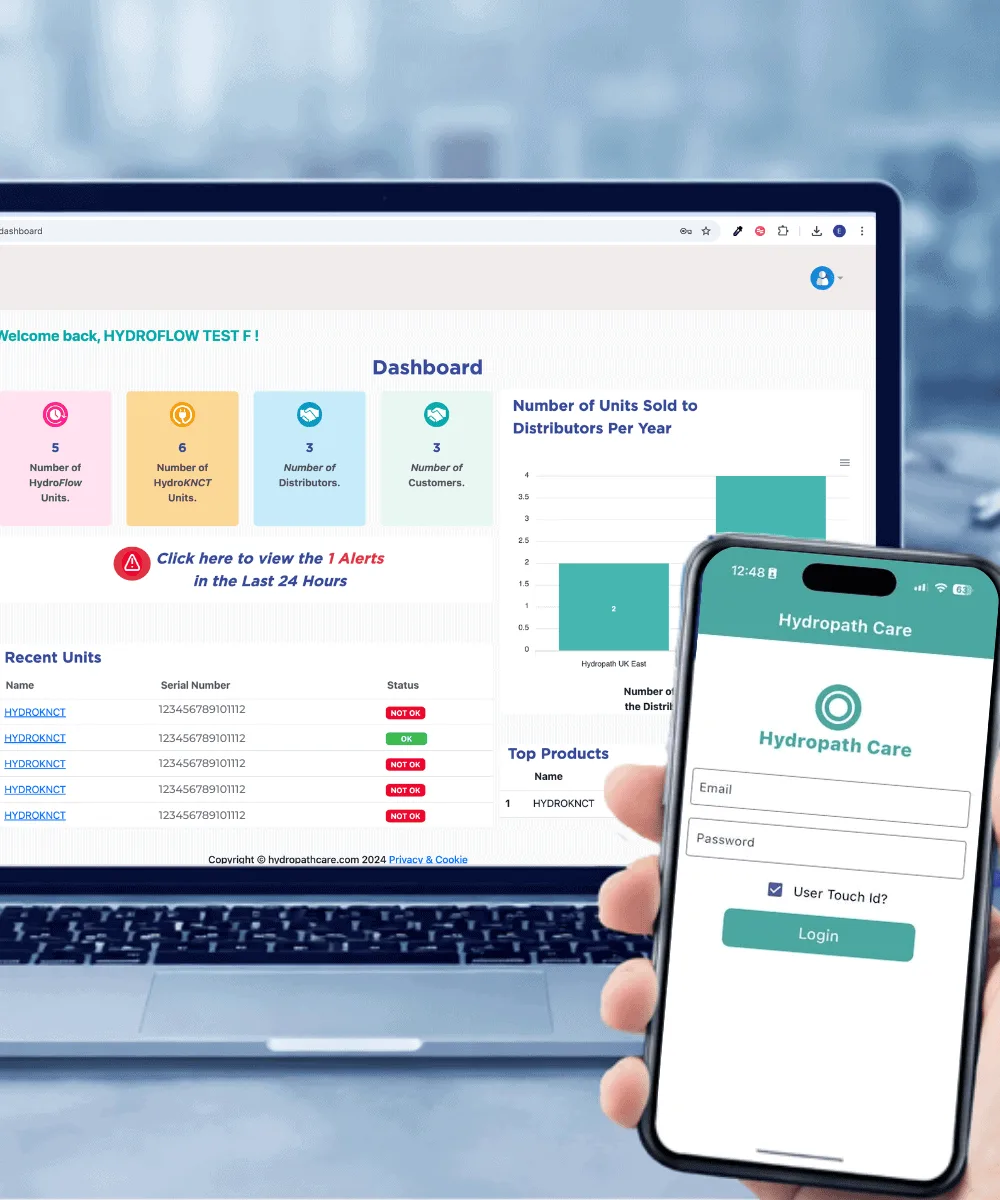
Hydropath Care dashboard

One device. One platform. Full transparency.

HydroKNCT and Hydropath Care are designed to work together as a single connected monitoring solution for every HydroFLOW installation across your network.

Real-time signal performance data from every unit

24/7 temperature and power monitoring

Instant alerts when readings change

Central dashboard for all sites

Full logging and trend transparency

FAQ

Your questions answered

Is the system safe for use in food production?
Yes. HydroFLOW is a physical system with no direct contact with the water and no chemical additives — no risk of residue in the product.
Does installation require shutting down the production line?
No. Installation is fully external and easy, with no system changes and no stopping production.
How does the system help with discharge regulation?
Improving wash-water quality and reducing its volume helps meet sewage-fee requirements and lowers the risk of fines for out-of-spec industrial discharge.

Ready to protect your production line?

Tell us about your plant and our team will estimate your expected annual savings — at no cost and with no obligation.