Public

Wastewater Treatment

HydroFLOW improves solids-separation processes, reduces chemical use and significantly cuts sludge volume and fines for out-of-spec discharge — with no shutdown of facilities.

Better solids separation Fewer chemicals Reduced sludge volume
The economic and environmental challenge

What’s driving up wastewater treatment costs in Israel?

Wastewater treatment plants and industrial facilities with process effluent face strict regulation and especially high operating costs.

01

Hard struvite deposits

In systems rich in phosphorus, magnesium and ammonia, an especially hard crystalline limescale forms, clogging pumps, pipework and anaerobic digesters.

✓ With HydroFLOWKeeping deposits as a powder-like sediment instead of hard limescale — fewer blockages.
02

High costs for polymers and chemicals

Sludge separation and clarification require a constant, heavy injection of costly polymers and coagulants.

✓ With HydroFLOWPhysical flocculation reduces the need for polymers.
03

Heavy fines for out-of-spec discharge

Exceeding COD, TSS or salinity limits triggers automatic fines of hundreds of percent, on top of the basic sewage fee of roughly NIS 5–7 per cubic metre.

✓ With HydroFLOWImproved effluent-quality parameters — less exposure to fines.
Energy efficiency and lower costs
HydroFLOW systems contribute significantly to treatment and wastewater facilities
Want proof first? See our installation results and case studies →
The solution

How does HydroFLOW improve wastewater treatment?

The system is installed fully externally on the pipework and transmits a unique signal that affects mineral behaviour. This helps maintain efficient flow, reduces blockages and cuts reliance on polymers and anti-foaming agents.

Less polymer use
Fewer polymers

Physical flocculation helps improve solids separation.

Struvite treatment
Fewer blockages

A trial at a large US plant validated a significant reduction in struvite build-up.

Less maintenance
Fewer system shutdowns

A significant reduction in system and equipment shutdowns for cleaning.

None
Facility shutdown

Fully external installation, with no downtime.

Installation process

Three steps to an advanced solution.

01

Installation

The HydroFLOW system is installed externally onto the wastewater pipework, with no cutting or system shutdown.

02

Treatment

A unique frequency affects mineral behaviour, helping maintain efficient flow.

03

Result

Fewer blockages, improved effluent-quality parameters and lower sludge-disposal costs.

How it works on struvite

Not dissolving it — changing where the crystals form

Struvite (magnesium ammonium phosphate) crystallises when magnesium, ammonia and phosphorus meet at a molar ratio close to 1:1:1, at a pH above roughly 7.5. Turbulence in a pump, a centrifuge, or a pressure drop releases CO₂ from the liquid, raising the pH and triggering crystallisation — exactly where the operator wants it least.

Slower build-up — not complete elimination

Even after treatment, struvite formation can’t be prevented entirely — but the rate at which it builds up on surfaces can be significantly slowed. The crystals tend to form within the liquid itself and flush away with the flow, instead of clinging to the drum, screw flights or pipe wall.

Accurate measurement starts from a clean baseline

We recommend the customer clean the system before starting the assessment, to allow an accurate measurement of the new build-up rate. In some systems the original build-up rate is especially fast — sometimes just 4 to 6 weeks — and in such cases the system helps slow the rate, but not stop it entirely.

The switch-off test — Walla Walla, Washington

What happens when you deliberately turn the unit off

Documented case study — Walla Walla facility, Washington, USA

Same equipment, same liquid, same operators — the only variable was whether the unit was running

30×30cm test sections on a drum and pan were cleaned down to bare metal. A HydroFLOW Custom unit was installed, and the sections were monitored over time — once with the unit running, and once deliberately switched off.

8 weeks — unit running

The cleaned drum section stayed completely free of new build-up. Pan deposits softened enough to rinse away with water.

7 weeks — unit switched off

Within 4 weeks: new limescale spreading. By week 7: about 3mm of hard limescale on the drum, and about 6mm on the pan — back to chisel work.

Read the full case study ←
Additional independently verified case studies

Documented results from wastewater treatment facilities

Zero
Anti-scalant dosing — Augusta, Georgia. Savings of roughly $4,000/month, payback in under 8 months.
Case study ←
30 → 4 hours
Screw-press cleaning time — Utah facility. Chemical spend cut $8,000/month, payback in 3 months.
Case study ←
20% less
Average daily polymer use, alongside 150 days with no cleaning stoppage — Water Conserv II, Orlando.
Case study ←
90 days
With no new limescale on a cleaned drum — Tulsa Southside, Oklahoma. The facility went on to fund treatment for all five presses.
Case study ←
60 days
Transfer pump at the Robert W. Hite facility, Denver. The plant purchased 4 additional units based on the results.
Case study ←
35 days
Over half of the first drum’s holes reopened — London, Ohio wastewater department. No chemical or mechanical cleaning.
Case study ←
Results from documented case studies published on the global Hydropath website (hydropath.com); results vary with liquid chemistry, sludge type and site baseline conditions.
Application map

Exactly where this works along the sludge line

Belt and screw presses

Where struvite is most visible — drums, pans, rollers and wash boxes.

Centrifuges

Turbulence in the separator releases CO₂ and raises pH — exactly where struvite crystallises. Feed-line treatment protects the unit and the centrate line downstream.

Centrate and sludge pipework

Hard, grey deposits narrow the pipe diameter and drive up pumping costs.

Feed pumps and valves

Pressure drops at pump passages make it the first component to clog — and the first pulled for acid cleaning.

DAF and flotation

The same signal that suppresses limescale also helps flocculation — less coagulant and polymer in flotation and effluent-treatment processes.

General polymer reduction

Physical flocculation improves filtration and dewatering efficiency along the entire treatment line, not just around the struvite.

Comparison

HydroFLOW vs. the three common methods

HydroFLOWChemical anti-scalantMechanical cleaning
Operating principleElectrical signal — crystallisation within the liquidChemical interferes with crystal formationRemoves deposits after they form
ConsumablesNoneOngoing purchase, storage and handlingAcid, high-pressure water, tools
Removing existing depositsGradual and assistive, over weeks to monthsNo — only prevents new build-up, as long as dosing continuesYes — fastest, but with downtime
Effect on the sewage liquidNone — nothing injected or removedAdds a substance to the streamActs on the deposit, not the liquid
Downtime for installation/useAbout an hour, no shutdownInjection point, dosing pump, monitoringEquipment shutdown for every cleaning
Dedicated struvite-recovery devices (such as Ostara Pearl, AirPrex) are not included in this comparison — they solve a different problem: deliberately precipitating struvite in a dedicated vessel, for harvesting and fertiliser production.
Applications

Who is it for?

Wastewater treatment plants

Improving solids-separation processes and reducing sludge volume.

Food, chemical, textile and paper plants

Reducing the risk of fines for out-of-spec industrial discharge.

Systems with struvite deposits

Protecting pumps, pipework and anaerobic digesters from blockages.

Management and control
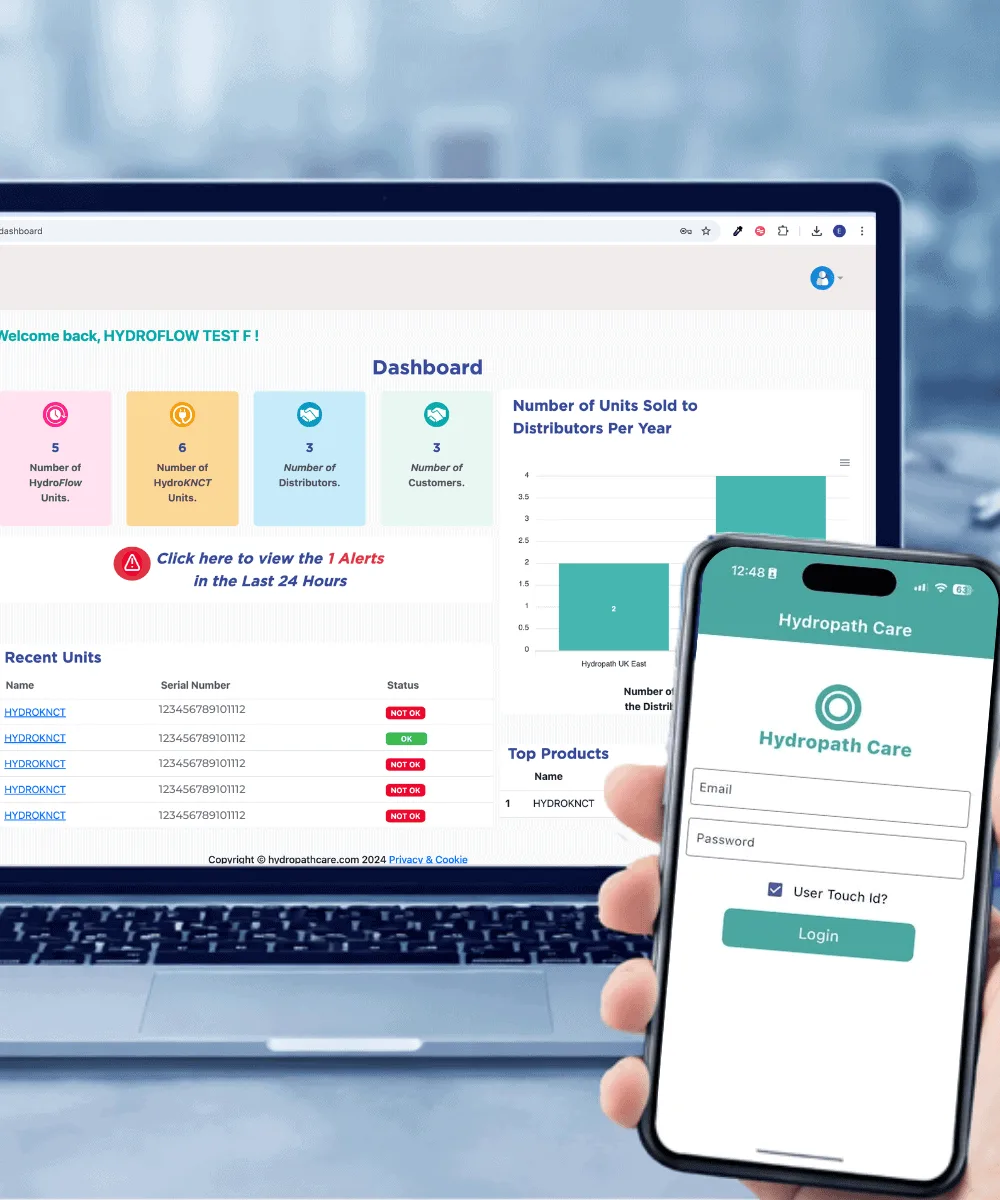
Hydropath Care dashboard

One device. One platform. Full transparency.

HydroKNCT and Hydropath Care are designed to work together as a single connected monitoring solution for every HydroFLOW installation across your network.

Real-time signal performance data from every unit

24/7 temperature and power monitoring

Instant alerts when readings change

Central dashboard for all sites

Full logging and trend transparency

FAQ

Your questions answered

How does the system reduce discharge fines?
Thanks to improved separation processes and reduced reliance on chemicals, effluent-quality parameters (such as COD and TSS) improve, lowering the risk of exceeding limits and facing automatic fines.
What is struvite and how does the system treat it?
Struvite is an especially hard crystalline deposit formed in systems rich in phosphorus and magnesium. HydroFLOW uses a unique frequency to keep the deposit as a powder-like sediment instead of hard limescale that clogs pumps and pipework.
Does installation require a facility shutdown?
No. Installation is fully external on the pipework, with no facility shutdown.

Ready to optimise your wastewater treatment?

Tell us about your facility and our team will estimate your expected savings — at no cost and with no obligation.