Public

Nursing Homes & Assisted Living

HydroFLOW provides full 24/7 protection for the water network, heating systems and cooling towers in nursing homes and assisted-living facilities — and helps reduce Legionella risk.

24/7 protection Supports Legionella risk reduction Cooling towers & heating systems
Operational and health challenges

What’s endangering your facility’s residents?

Managing water and energy in assisted-living and nursing facilities requires balancing resident health against high operating costs.

01

Critical health risk — Legionella

Nursing-home residents are in the highest-risk group for severe illness from Legionella bacteria, which multiplies in biofilm in hot-water systems and cooling towers.

✓ With HydroFLOWUp to 99% bacteria reduction including Legionella (depending on the site), per independent validation.
02

Rising water, sewage and energy bills

A full water-utility tariff of roughly NIS 11.5–14 per cubic metre plus sewage fees of roughly NIS 5–7 per cubic metre, combined with limescale in heating boilers, drives up electricity, gas or diesel bills.

✓ With HydroFLOWKeeping boilers and heat exchangers clean — direct energy savings.
03

Accelerated wear in residents’ rooms

Limescale clogs taps and showerheads, reduces water pressure and creates stains requiring aggressive cleaning.

✓ With HydroFLOWLimescale reduction — less wear and lower maintenance costs.

Caregiver assisting a resident
24/7
Continuous treatment, whether water is flowing or standing still
Want proof first? See our installation results and case studies →
The solution

How does HydroFLOW protect your facility?

Patented technology providing full 24/7 protection for the water network, heating systems and cooling towers. The system breaks down biofilm in the pipework and helps reduce Legionella risk, while saving on energy, water and maintenance costs.

Independent lab validation
SGS and ALS

Significant bacteria reduction, including Legionella, following biofilm disruption. The exact result varies by site.

24/7
Continuous protection

A continuous signal across all water and heating systems.

No
Added chemicals

A physical solution, with no additives or contact with the water.

No
Disruption to residents

Quiet, fully external installation, with no pipe cutting.

Installation process

Three steps to an advanced solution.

01

System assessment

Our technical team carries out a full assessment of the water and HVAC systems.

02

Installation

Quiet, external installation, with no pipe cutting and no disruption to residents.

03

Ongoing protection

A continuous signal operating 24 hours a day protects all systems, with the option to connect to the HydroKNCT monitoring system.

A striking figure

Nursing homes: more Legionella cases than hospitals

80%
of definite healthcare-associated Legionnaires’ disease cases in the US were traced to nursing and long-term care facilities — versus just 18% to hospitals.

The reason: nursing-home residents live on-site continuously for months or years, while hospital stays typically last only days — the longer exposure window raises real-world risk.

Source: CDC, MMWR 2017;66:584–589 — surveillance data from 20 states and one large metropolitan area, USA, 2015 data
Why it’s different from a hospital

Not “a smaller hospital” — a different kind of risk

Hospital

Short stays, fast patient turnover

Most taps and showers are in relatively frequent use.

Nursing home / assisted living

Long-term residency, months to years

Wings with low water use develop slow, stagnant flow — exactly the conditions biofilm and Legionella need.

Rehabilitation and treatment

Hydrotherapy pools

Less common in general hospitals

Some assisted-living communities and nursing homes in Israel operate hydrotherapy pools for rehabilitation. Balancing proper disinfection with comfort for sensitive residents makes physical treatment, without adding more chemicals, a meaningful advantage.

Case study — USA

Indiana hospital: Legionella below 1 CFU/mL within 16 days

Documented case study

From an average of 7 CFU/mL to below 1 CFU/mL

Quarterly tests at a hospital in Indiana showed Legionella above the target of 1 CFU/mL, with contamination averaging 7 CFU/mL. Flushing and equipment replacement were expensive, and a $75,000 treatment system was being considered. In July 2022, as a 90-day proof of concept, a HydroFLOW i100 was fitted on the incoming potable main (four-inch pipe) and an S38 on the line serving 14 ice machines. Within 16 days counts fell to 1 CFU/mL or non-detectable, and results were reported as stable after 15 months. The $75,000 treatment system was not needed.

Average contamination before installation7 CFU/mL
Days to fall below 1 CFU/mL16
Months of reported stability15
Read the full case study →

Results as reported in a case study published on the Hydropath website; results vary by site, and HydroFLOW does not replace the facility’s water-safety plan.

Applications

Who is it for?

Nursing homes and care centres

Comprehensive protection for water systems for all residents.

Assisted-living communities

Maintaining health standards alongside savings in ongoing operating costs.

Senior residential towers

Reducing wear on equipment and taps in residents’ apartments.

Management and control
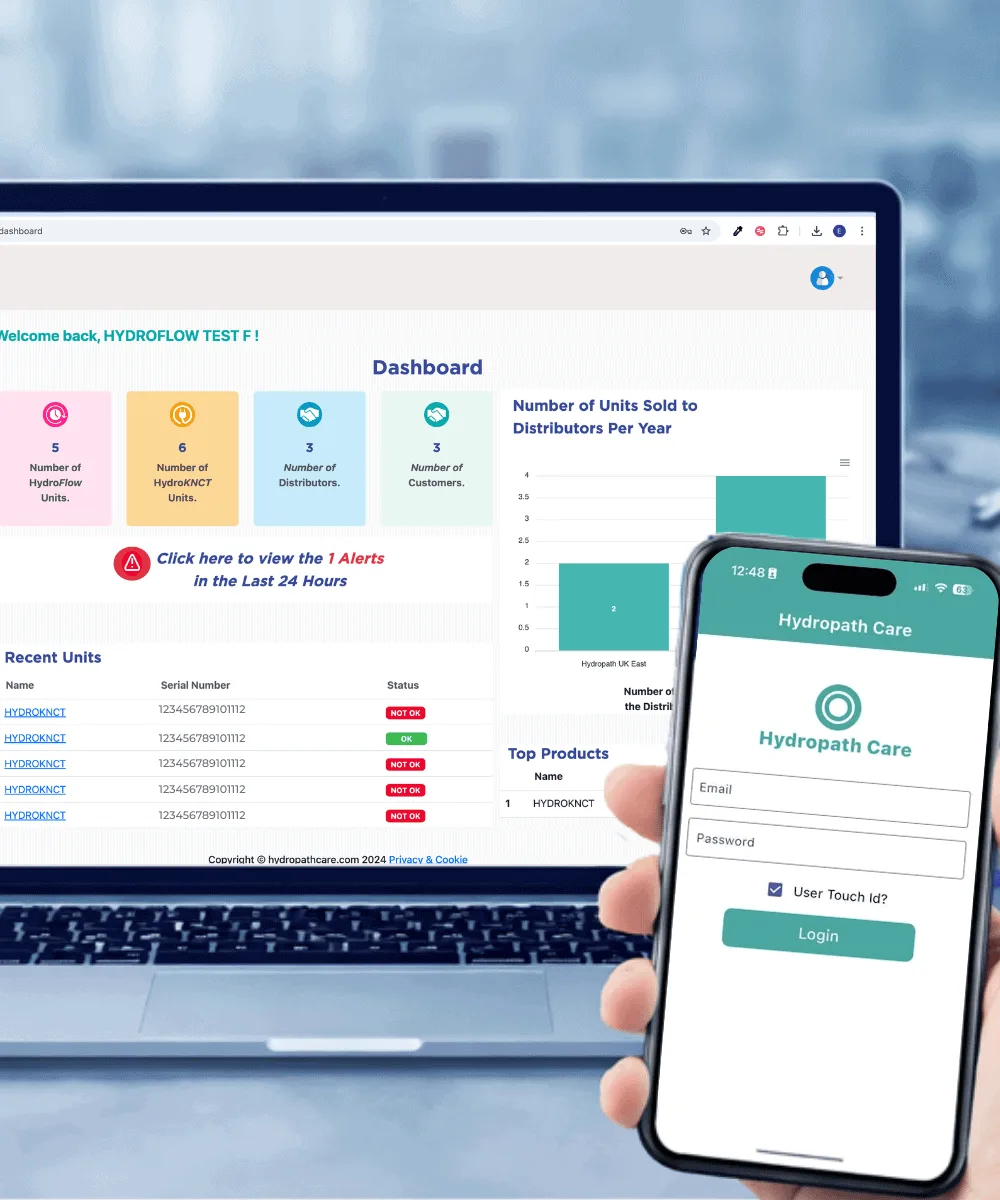
Hydropath Care dashboard

One device. One platform. Full transparency.

HydroKNCT and Hydropath Care are designed to work together as a single connected monitoring solution for every HydroFLOW installation across your network.

↑

Real-time signal performance data from every unit

↑

24/7 temperature and power monitoring

↑

Instant alerts when readings change

↑

Central dashboard for all sites

↑

Full logging and trend transparency

FAQ

Your questions answered

Why is Legionella especially dangerous in nursing homes?
Residents of nursing homes and assisted-living facilities are in the highest-risk group for severe illness and death from Legionnaires’ disease. HydroFLOW helps reduce bacteria including Legionella by up to 99%, depending on the site. HydroFLOW is not a disinfectant and does not replace the facility’s water-safety plan.
Does installation disrupt residents’ routine?
No. Installation is fully external and quiet, with no pipe cutting and no disruption to the facility’s operations.
Does the system also help save money?
Yes. Alongside health protection, the system saves on water, sewage, energy and maintenance costs.

Ready to protect your facility’s residents?

Tell us about your systems and our team will estimate your expected annual savings — at no cost and with no obligation.