Public
HydroFLOW improves solids-separation processes, reduces chemical use and significantly cuts sludge volume and fines for out-of-spec discharge — with no shutdown of facilities.
Wastewater treatment plants and industrial facilities with process effluent face strict regulation and especially high operating costs.
In systems rich in phosphorus, magnesium and ammonia, an especially hard crystalline limescale forms, clogging pumps, pipework and anaerobic digesters.
Sludge separation and clarification require a constant, heavy injection of costly polymers and coagulants.
Exceeding COD, TSS or salinity limits triggers automatic fines of hundreds of percent, on top of the basic sewage fee of roughly NIS 5–7 per cubic metre.
The system is installed fully externally on the pipework and transmits a unique signal that affects mineral behaviour. This helps maintain efficient flow, reduces blockages and cuts reliance on polymers and anti-foaming agents.
Physical flocculation helps improve solids separation.
A trial at a large US plant validated a significant reduction in struvite build-up.
A significant reduction in system and equipment shutdowns for cleaning.
Fully external installation, with no downtime.
The HydroFLOW system is installed externally onto the wastewater pipework, with no cutting or system shutdown.
A unique frequency affects mineral behaviour, helping maintain efficient flow.
Fewer blockages, improved effluent-quality parameters and lower sludge-disposal costs.
Struvite (magnesium ammonium phosphate) crystallises when magnesium, ammonia and phosphorus meet at a molar ratio close to 1:1:1, at a pH above roughly 7.5. Turbulence in a pump, a centrifuge, or a pressure drop releases CO₂ from the liquid, raising the pH and triggering crystallisation — exactly where the operator wants it least.
Even after treatment, struvite formation can’t be prevented entirely — but the rate at which it builds up on surfaces can be significantly slowed. The crystals tend to form within the liquid itself and flush away with the flow, instead of clinging to the drum, screw flights or pipe wall.
We recommend the customer clean the system before starting the assessment, to allow an accurate measurement of the new build-up rate. In some systems the original build-up rate is especially fast — sometimes just 4 to 6 weeks — and in such cases the system helps slow the rate, but not stop it entirely.
30×30cm test sections on a drum and pan were cleaned down to bare metal. A HydroFLOW Custom unit was installed, and the sections were monitored over time — once with the unit running, and once deliberately switched off.
The cleaned drum section stayed completely free of new build-up. Pan deposits softened enough to rinse away with water.
Within 4 weeks: new limescale spreading. By week 7: about 3mm of hard limescale on the drum, and about 6mm on the pan — back to chisel work.
Where struvite is most visible — drums, pans, rollers and wash boxes.
Turbulence in the separator releases CO₂ and raises pH — exactly where struvite crystallises. Feed-line treatment protects the unit and the centrate line downstream.
Hard, grey deposits narrow the pipe diameter and drive up pumping costs.
Pressure drops at pump passages make it the first component to clog — and the first pulled for acid cleaning.
The same signal that suppresses limescale also helps flocculation — less coagulant and polymer in flotation and effluent-treatment processes.
Physical flocculation improves filtration and dewatering efficiency along the entire treatment line, not just around the struvite.
| HydroFLOW | Chemical anti-scalant | Mechanical cleaning | |
|---|---|---|---|
| Operating principle | Electrical signal — crystallisation within the liquid | Chemical interferes with crystal formation | Removes deposits after they form |
| Consumables | None | Ongoing purchase, storage and handling | Acid, high-pressure water, tools |
| Removing existing deposits | Gradual and assistive, over weeks to months | No — only prevents new build-up, as long as dosing continues | Yes — fastest, but with downtime |
| Effect on the sewage liquid | None — nothing injected or removed | Adds a substance to the stream | Acts on the deposit, not the liquid |
| Downtime for installation/use | About an hour, no shutdown | Injection point, dosing pump, monitoring | Equipment shutdown for every cleaning |
Improving solids-separation processes and reducing sludge volume.
Reducing the risk of fines for out-of-spec industrial discharge.
Protecting pumps, pipework and anaerobic digesters from blockages.
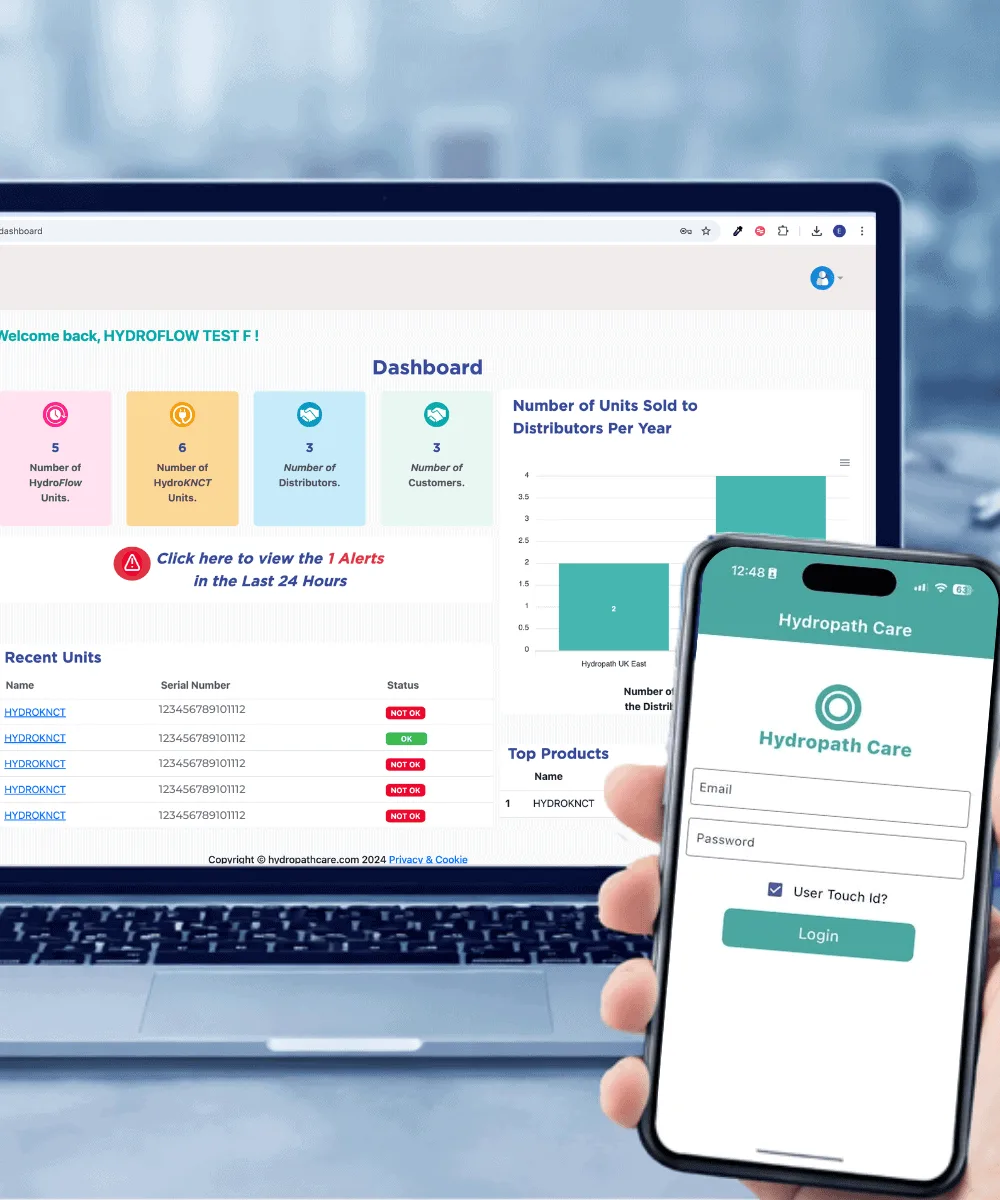
HydroKNCT and Hydropath Care are designed to work together as a single connected monitoring solution for every HydroFLOW installation across your network.
Real-time signal performance data from every unit
24/7 temperature and power monitoring
Instant alerts when readings change
Central dashboard for all sites
Full logging and trend transparency
Tell us about your facility and our team will estimate your expected savings — at no cost and with no obligation.