Industry

Power Plants

HydroFLOW protects the condensers, heat exchangers and cooling towers at your power plant — maintaining optimal turbine vacuum and dramatically cutting water, sewage and maintenance costs.

Protects condensers & heat exchangers Optimal turbine vacuum Lower water & wastewater costs
The economic and operational burden

What’s hurting your power plant’s efficiency?

Power plants depend on the efficiency of their cooling systems and heat exchangers. Israel’s hard water creates three key challenges.

01

Microbiologically induced corrosion (MIC) in intake piping and heat exchangers

In cooling systems using seawater or brackish water, microbiologically induced corrosion (MIC) forms corrosion tubercles in intake piping, strainers and heat exchangers. The process accelerates equipment wear, increases dependence on anti-corrosion chemicals and leads to frequent system openings for cleaning and inspection.

✓ With HydroFLOWSignificant reduction in MIC corrosion along the intake system, alongside a marked drop in the frequency of maintenance shutdowns — as measured at the Enaex facility in Antofagasta, Chile.
02

Turbine efficiency loss from limescale

A microscopic layer of limescale on condensers damages turbine vacuum, forcing the plant to burn more fuel for the same MW output.

✓ With HydroFLOWPreventing new limescale build-up preserves thermal efficiency and turbine vacuum.
03

High water costs and sewage fees

Israel’s industrial water tariff is roughly NIS 11.5–14 per cubic metre, and every cubic metre of blow-down carries an additional sewage fee of roughly NIS 5–7 per cubic metre.

✓ With HydroFLOWRaising cycles of concentration significantly reduces how often blow-down is required.
04

Costly maintenance and shutdowns (macro-fouling)

Beyond limescale, cooling systems suffer from biofilm and algae. Chemical treatment requires large budgets and accelerates pipe corrosion.
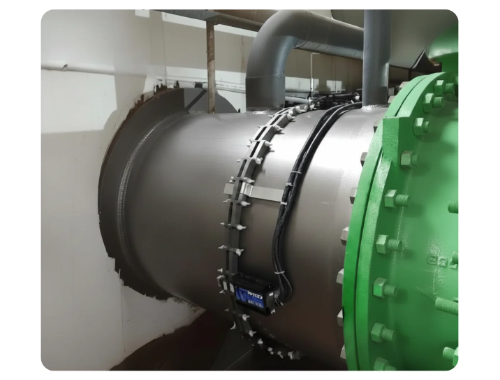

✓ With HydroFLOWReducing biofilm and corrosion means fewer shutdowns for mechanical cleaning.
Power plant with HydroFLOW unit installed
Fewer faults
HydroFLOW systems reduce limescale, bacteria, biofilm and corrosion damage at power plants
Want proof first? See our installation results and case studies →
The solution

How does HydroFLOW protect the power plant?

The system is installed fully externally on the cooling-water pipework — no cutting, no plant shutdown. The unique electrical signal helps maintain optimal condenser vacuum, cuts energy costs and dramatically reduces blow-down volumes.

Within a week
Anti-scalant dosing stopped completely

Based on a documented case study: a 600MW power plant, China — chemical dosing stopped completely within a week of installation.

1.5°C
Drop in condenser discharge temperature

A measured drop in cooling-water temperature at the condenser outlet — a direct indication of improved heat transfer and turbine vacuum.

4 months
No hard limescale on the condenser

After 4 months of treatment, only a soft powder remained that rinses off easily with the water flow — instead of a hard limescale layer.

None
Plant shutdown

Fully external installation — no cutting, welding or stopping production.

Seawater cooling

Most of Israel’s power plants sit right on the coast

Why this changes the priorities

  • Rutenberg, Orot Rabin, Reading and Eshkol — all on the coast, all sea-water cooled
  • In warm seawater, biofilm and algae dominate more than classic limescale
  • The same HydroFLOW system addresses both — but the emphasis at a sea-water power plant differs from a freshwater one
See all power-plant case studies on the Hydropath website ←

Documented results from sea-water-cooled power plants

Datan Power Station, Taiwan

A 250-micron biofilm layer severely damaged heat transfer

  • Before treatment: condenser cleaning was required as often as every two months
  • Each cleaning caused a shutdown of 3 days or more
  • Seawater was used as the direct condenser coolant — essentially the same scenario as Israel’s plants
600MW power plant, China

Chemical dosing stopped completely within a week

  • Installed on two steam condensers
  • After 4 months: no hard limescale, only a soft powder that rinses off easily
  • A 1.5°C drop in discharge temperature, and chemical-free discharge water was reused on site

What the system treats — and what it doesn’t

An important limitation, stated plainly: HydroFLOW is highly effective against biofilm and micro-fouling (the initial layer that builds up on condenser surfaces). For larger organisms — such as mussels and barnacles that settle inside the seawater intake structures themselves — the system complements, and does not replace, dedicated Marine Growth Prevention measures at the intake structures.

Less anti-scalant = less phosphonate discharged to the sea

Worth considering

Environmental monitoring reports along Israel’s coastline track phosphonate (an anti-scalant residue) in the concentrate discharge of marine facilities. Less chemical anti-scalant means less of that load.

Installation process

Three steps to an advanced solution.

01

Installation

The HydroFLOW system is installed externally onto the cooling-water pipework at the power plant, with no cutting or plant shutdown.

02

Treatment

A patented electrical signal propagates along the entire cooling-water system — continuously, 24/7.

03

Result

Clean heat-exchanger surfaces, stable turbine efficiency and reduced blow-down volumes.

Applications

Who is it for?

Conventional power plants

Protecting steam condensers and heavily loaded cooling towers.

CHP cogeneration facilities

Maintaining heat-exchanger efficiency in cogeneration engines.

Industrial power-generation facilities

Installed in landmark projects worldwide, including power plants in China and Russia.

Management and control
Hydropath Care dashboard

One device. One platform. Full transparency.

HydroKNCT and Hydropath Care are designed to work together as a single connected monitoring solution for every HydroFLOW installation across your network.

Real-time signal performance data from every unit

24/7 temperature and power monitoring

Instant alerts when readings change

Central dashboard for all sites

Full logging and trend transparency

FAQ

Your questions answered

How does limescale affect electricity production?
A microscopic layer of limescale on condenser surfaces acts as a thermal insulator, damages turbine vacuum and forces the plant to burn more fuel for the same MW output.
Does installation require a plant shutdown?
No. Installation is fully external to the existing pipework, with no cutting, welding or shutdown.
Does it suit very large-diameter pipework too?
Yes. For power plants and heavy industrial facilities, the Custom Range is engineered specifically for pipework over 220mm in diameter.

Ready to maximise your plant’s energy efficiency?

Tell us about your system and our team will estimate your expected annual savings — at no cost and with no obligation.