Industry

Cooling Towers & HVAC Systems

HydroFLOW protects your cooling towers from limescale and biofilm, raises cycles of concentration and dramatically cuts blow-down volumes — no chemicals, no system shutdown.

Protection from limescale & biofilm Higher cycles of concentration No chemicals
The real economic burden

What’s driving up the cost of running your cooling tower?

Cooling towers are the heaviest water consumers in commercial buildings and industrial plants. Managing them the traditional way creates an economic burden from three directions.

01

Expensive industrial water tariffs

Water for businesses and industry costs roughly NIS 11.5–14 per cubic metre. An average cooling tower consumes tens of thousands of cubic metres a year just for make-up water.

✓ With HydroFLOWHigher cycles of concentration and reduced blow-down — less water purchased, less water discharged.
02

Chemical treatment

Ongoing use of biocides, scale inhibitors and acids involves costs for materials, storage, dosing and control — alongside safety and environmental considerations.

✓ With HydroFLOWDependency on intensive chemical treatment can be reduced, cutting material use, maintenance work and the system’s environmental impact.
03

Biofilm and microbial growth

The heat and recirculation conditions in cooling systems can encourage biofilm formation and microbial growth, harming system efficiency and raising sanitary risks, including Legionella.

✓ With HydroFLOWHelps reduce biofilm formation and lower microbial and algae load — as part of an overall water quality and hygiene management plan.
04

Fines for out-of-spec discharge

With traditional chemical treatment, water is saturated with biocides and acids. Exceeding water-corporation limits can send discharge tariffs up by hundreds of percent.

✓ With HydroFLOWNo chemicals — less risk of exceeding limits and facing environmental fines.
Lower costs
HydroFLOW systems reduce energy and water costs in cooling towers
Want proof first? See our installation results and case studies →
The solution

How does HydroFLOW protect the cooling tower?

The system is installed externally on the water pipework, with no cutting and no shutdown. A unique electrical signal at ~150 kHz reduces limescale adhesion to pipe walls and heat-exchanger surfaces, and disrupts bacterial biofilm from establishing — allowing you to raise cycles of concentration and cut blow-down.

Up to 85%
Less freshwater and sewage

Based on a documented case study: an 85% reduction in blow-down at a Fortune 100 company headquarters, Houston, USA.

Read the case study ←
16%
Energy efficiency gain

Based on a documented case study: a 16% efficiency gain in a chiller system at a bank building, Hong Kong.

Read the case study ←
Up to 75%
Fewer biocides

Based on a documented case study: a 75% chemical reduction at an industrial factory, Texas.

Read the case study ←
None
Infrastructure changes

No cutting, welding or downtime — the tower keeps running throughout the entire installation.

Tool

Water Savings Potential Calculator

Enter your cooling tower’s data to get an initial estimate of water savings potential (and optionally chemical savings) with HydroFLOW.

Cycles of concentration

What are “cycles of concentration” — and why do they save so much water?

The more successfully limescale is controlled, the more cycles the water can complete in the cooling tower before it needs to be drained (blow-down) — meaning less fresh water is needed and less water is discharged to sewage.

For example: at one industrial site, after treatment with HydroFLOW, the number of cycles of concentration rose from about 4 cycles to 20 cycles — a dramatic drop in the amount of blow-down water required, and exactly why there’s such a large gap in water consumption between a treated and an untreated tower.

420
Cycles of concentration, example industrial site

Biofilm: the bigger thermal damage

Limescale and biofilm are usually mentioned together, but their impact on heat efficiency differs by a significant order of magnitude.

~7%
Limescale

Just one millimetre of limescale on a heat exchanger reduces heat-transfer efficiency by about 7%.

~50%
Biofilm

Just one millimetre of biofilm can harm thermal efficiency by up to 50% — several times more than limescale.

Not all chemicals are reduced to the same extent

Rather than a single figure, a more precise picture distinguishes between the two common types of chemical treatment in cooling towers.

Scale inhibitors

Significant reduction, up to full elimination

When limescale is effectively controlled with HydroFLOW, the use of chemical scale inhibitors can usually be cut significantly — and in many cases eliminated entirely.

Biocides

About 50–75% reduction, not full elimination

Most cooling towers still benefit from some level of biocide dosing alongside the physical treatment — not a full replacement, but a significant reduction in the amount required.

Cooling towers: the highest-risk equipment for Legionella

Cooling towers are considered one of the leading types of equipment at risk of Legionella outbreaks — warm water, slow flow in certain areas, and limescale and biofilm that create a habitat protected from disinfectants. Reducing limescale and biofilm with HydroFLOW helps lower that risk, as part of an overall Legionella management programme — not as a replacement for required sanitation protocols.

Documented results from cooling towers worldwide

100+ units
Limescale gone within 12 months — 50+ malls, Hong Kong
Read the case study →
16%
Chiller efficiency gain — bank building, Hong Kong
Read the case study →
68%
Less blow-down — municipal building, Arizona
Read the case study →
75%
Chemical reduction — factory, Texas
Read the case study →
Installation process

Three steps to an advanced solution.

01

Installation

The HydroFLOW system is installed externally onto the cooling-water pipework, with no cutting or cooling-tower shutdown.

02

Treatment

An electrical signal is induced along the entire water system — continuously, 24 hours a day.

03

Result

Existing limescale gradually breaks down; you can raise cycles of concentration and cut blow-down within weeks.

Applications

Who is it for?

Data Centers

Efficient management of cooling water, maintaining heat transfer and supporting the operational continuity of critical infrastructure.

Cooling towers in office buildings and malls

Maintaining cooling efficiency with no disruption to the building’s day-to-day operations.

Cooling towers at industrial plants

Protecting heavily loaded cooling systems, alongside significant savings in water and sewage costs.

Hotels and institutional facilities

Reducing Legionella risk alongside operational savings, with no need to shut down cooling systems.

Management and control
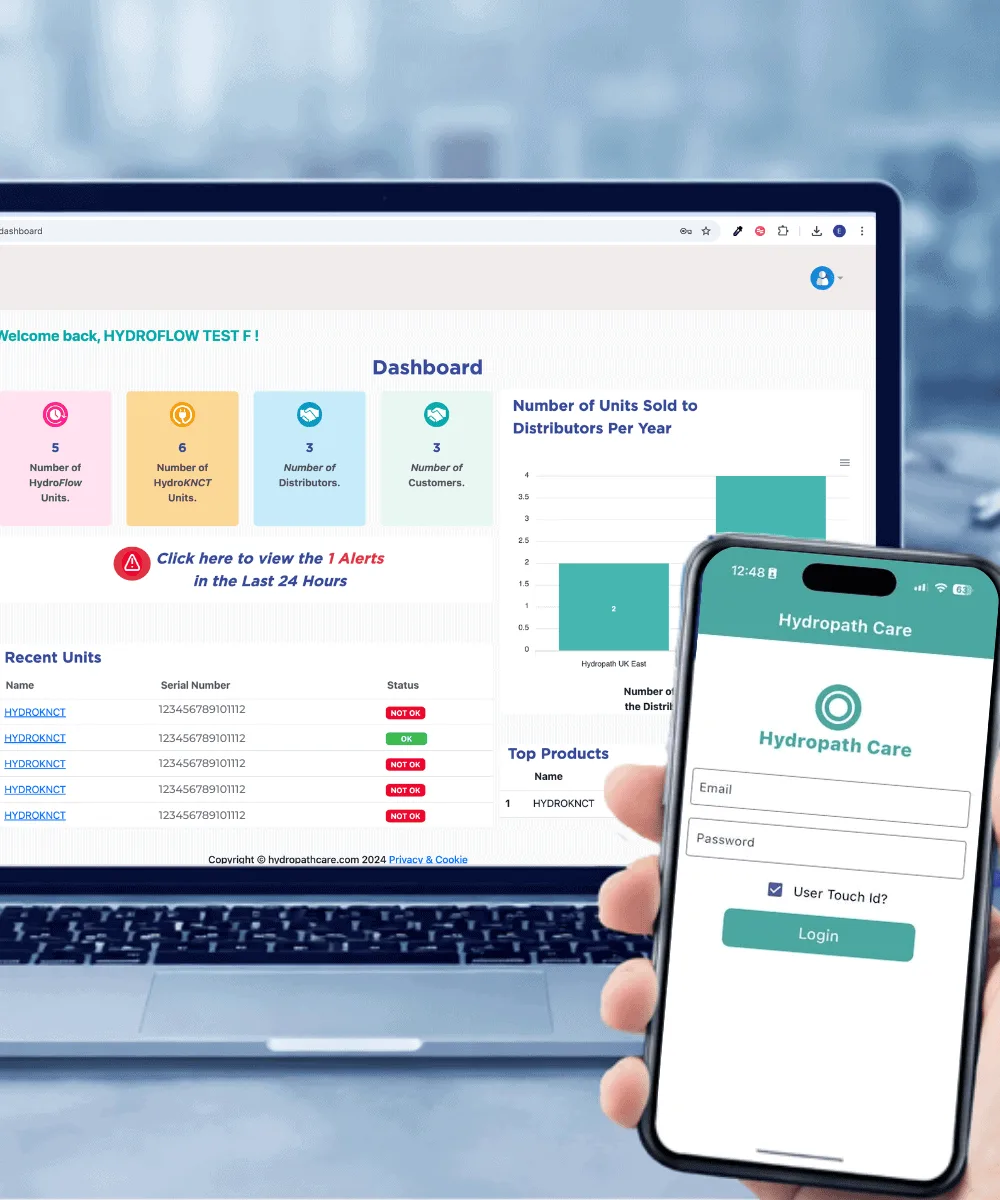
Hydropath Care dashboard

One device. One platform. Full transparency.

HydroKNCT and Hydropath Care are designed to work together as a single connected monitoring solution for every HydroFLOW installation across your network.

Real-time signal performance data from every unit

24/7 temperature and power monitoring

Instant alerts when readings change

Central dashboard for all sites

Full logging and trend transparency

FAQ

Your questions answered

How much water can be saved in a cooling tower?
According to the Solar Impulse Foundation, using HydroFLOW in cooling towers is expected to reduce freshwater and sewage consumption by up to about 85%, thanks to higher cycles of concentration and reduced blow-down.
Does installation require shutting down the tower?
No. The unit is installed externally on the existing pipework, with no cutting, welding or shutdown. The tower keeps operating throughout the entire installation.
Does the system reduce the risk of discharge fines?
Yes. Thanks to reduced chemical and biocide use, the risk of exceeding water-corporation limits and facing fines for out-of-spec industrial discharge is also lowered.
Can electronic water treatment replace cooling tower chemicals?
HydroFLOW can significantly reduce chemical use, though the extent depends on the chemical type. Anti-scalant use can typically be cut by around 80%, and there are many documented cases where anti-scalant use was eliminated entirely. For biocides, HydroFLOW typically enables a reduction of about 40% to 75% rather than full elimination, since most cooling towers still benefit from some level of biocidal treatment. Depending on the size of your tower, more than one HydroFLOW unit may be required — one for the heat exchanger/condenser and possibly another for the tower’s spray arms. We recommend a site survey to determine the right installation for your system.

Ready to cut your cooling tower’s costs?

Tell us about your system and our team will estimate your expected annual savings — at no cost and with no obligation.