Filtration Technology
A media filter that cleans itself, without a conventional backwash — up to 95% less cleaning water, no routine media replacement, and consistent 10-micron filtration. Based on patented technology by BallTech, brought to Israel by Hydropath Technology.
Global water demand keeps growing, and tariffs keep rising — yet a conventional media filter sends water that has already been pumped, treated and paid for straight to drain, every single clean.
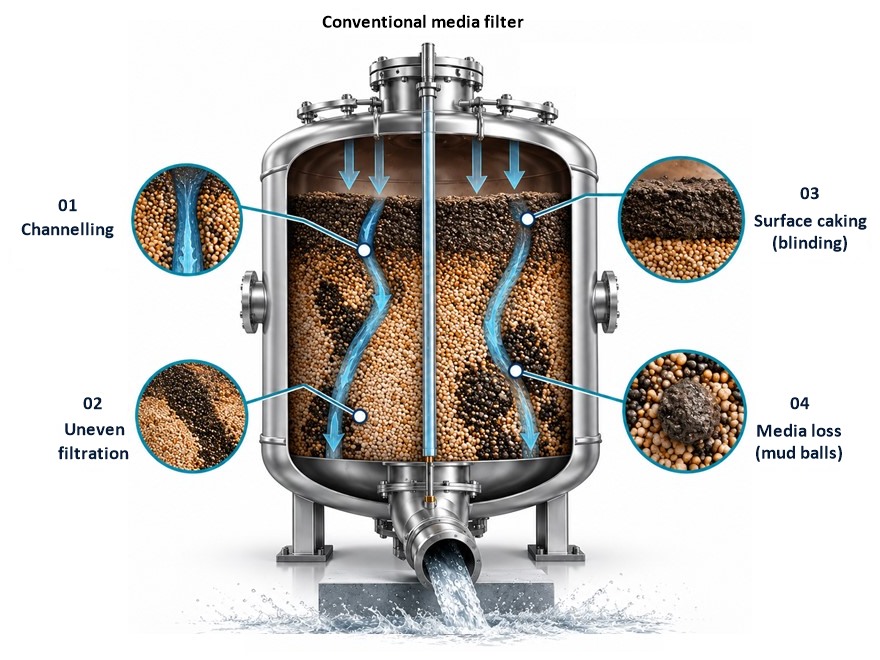
Water finds pathways of lower resistance and bypasses parts of the media, reducing filtration efficiency.
Only part of the media is effectively used, which can allow contaminants to pass through the filter.
Suspended solids accumulate on the top layer of the media, forming a dense cake that reduces filtration capacity and increases cleaning frequency.
Trapped solids can form hard clumps within the media, reducing effective filtration and making cleaning difficult.
A media filter that cleans itself, without a conventional backwash. Pressurised driving water powers a Venturi tube that withdraws media from the bottom of the bed, cleans it mechanically of dirt, and returns it clean to the vessel — so every grain takes its turn at the working layer. Only the separated dirty water leaves the system, to drain.
A conventional 30″ filter can use up to about 6,300 litres of cleaning water per clean. RevoMedia — about 100 litres.
The media is mechanically regenerated every cycle, instead of top-ups or a full change like conventional filters.
90 to 95% filtration efficiency, versus 15 to 20 microns on many conventional filters.
No routine manual intervention — the system detects when cleaning is needed and runs it on its own.
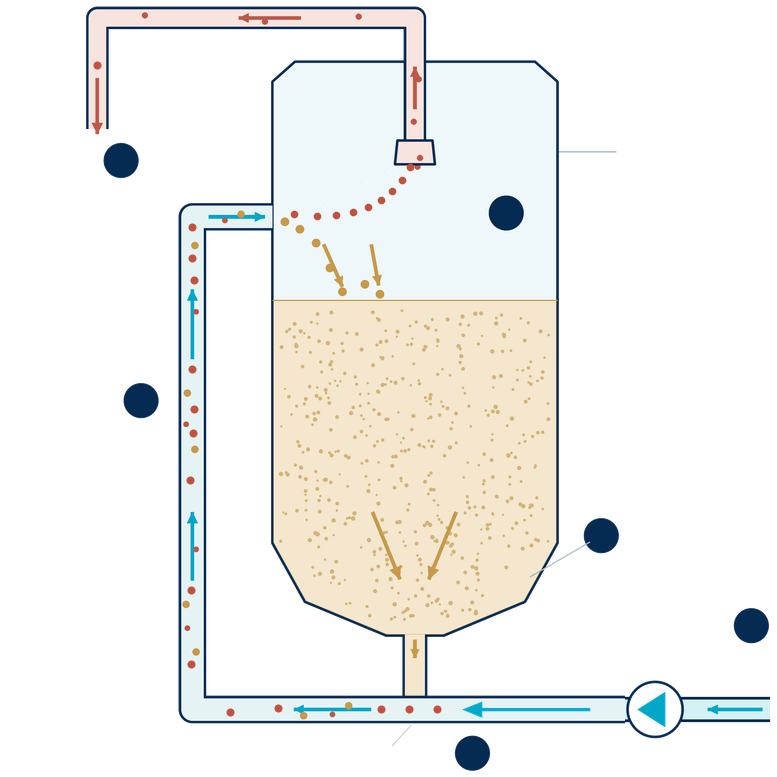
In filtration mode, water flows down through the media bed and the solids are trapped in the media. To clean, RevoMedia circulates the media through an external hydraulic loop. The media is cleaned in a Venturi tube and separated in the upper vessel, and the dirty water leaves separately, to drain.
Pressurised water drives the Venturi tube below the vessel.
Media is drawn from the bottom of the bed into the suction chamber.
High-speed flow and turbulence detach dirt from the grains.
Water, media and loosened dirt travel up this pipe.
In the upper vessel, clean media settles back onto the bed.
A central pickup removes the dirty water and solids to drain.
Upper separation zone
Media bed
Venturi passage
High-speed flow and turbulence detach dirt from the grains.
Water, media and loosened dirt rise together in the media recirculation pipe.
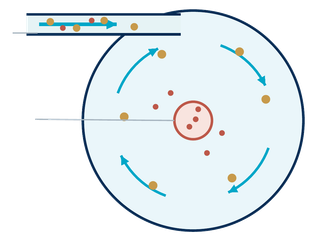
A tangential inlet creates a swirling flow that separates the media from the released solids.
A central pickup removes the dirty water and solids.
The media settles downward and stays in the vessel.
Simplified process schematic, not to scale. Only the separated dirty water leaves the system.
Most solids are trapped in the top few centimetres of a media bed. RevoMedia withdraws media from the bottom and returns it to the top after cleaning, so every grain takes its turn at the working layer — instead of sitting “dead” at the bottom of the vessel, as happens in conventional filters.
| Criterion | Conventional | RevoMedia™ |
|---|---|---|
| Cleaning water per clean (30″) | Up to ~6,300 L | ~100 L |
| How the media is cleaned | Flow reversed through bed | Circulated and cleaned mechanically |
| Where the cleaning water goes | Backwash flow to waste | Dirty water only, to drain |
| Media replacement | Top-ups or full change | No routine replacement required |
| Sticky solids | Can clump | Built for sticky and organic solids |
| Fine filtration | Often 15–20 µm | 10 µm |
The ideal application: recirculating systems, such as cooling towers and chilled-water circuits. The pump draws from the tower basin, and HydroFLOW on the feed line treats the water before every pass through the filter. As the water recirculates, each cycle removes more flocs.
HydroFLOW’s signal encourages fine particles and colloids to agglomerate into larger flocs the media can capture.
HydroFLOW helps reduce scale and biofilm on the media, Venturi tube and pump; RevoMedia mechanically removes the captured solids.
Less clogging in the bed means fewer cleaning cycles — on top of up to 95% less water per clean.
Treated water returns to the tower: HydroFLOW helps reduce scale, biofilm and chemical use in the tower and heat exchangers.
For larger flows, units can be run in parallel. Filtration performance depends on the selected media, filtration velocity and application conditions.
| Model | Flow m³/h | Inlet / outlet | Pump | Tank Ø |
|---|---|---|---|---|
| RevoMedia 24 | 7 (31 gpm) | 1-1/2″ | 3 kW | 610 mm |
| RevoMedia 30 | 11 (48 gpm) | 1-1/2″ | 3 kW | 762 mm |
| RevoMedia 36 | 16 (70 gpm) | 2″ | 3 kW | 915 mm |
| RevoMedia 48 | 30 (132 gpm) | 3″ | 7.5 kW | 1,220 mm |
| RevoMedia 60 | 50 (220 gpm) | 3″ | 11 kW | 1,524 mm |
Illustrative. One 30″ filter cleaned daily. BallTech comparison data; typical water and wastewater tariffs in Europe (EurEau 2026) and US cities, 2025–2026. Excludes energy and wastewater treatment on site.
| Scenario | Cleaning water / year | Cost — Conventional | Cost — RevoMedia | Saving / year |
|---|---|---|---|---|
| Lower tariff ($2.50/m³) — Spain, Italy, Chicago | 2,300 m³ → 37 m³ | $5,750 | $93 | $5,658 |
| Higher tariff ($6.00/m³) — Belgium, Netherlands, LA | 2,300 m³ → 37 m³ | $13,800 | $222 | $13,578 |
Ten filters: US$56,600 to US$135,800 saved a year
Around 50 filters installed worldwide, some running about 10 years with no media change.
100 m³/h — cooling-tower and chilled-water filtration.
Process water recycled — caustic wash water recycling in steel-plate manufacturing.
Injection-mould cooling water — improved from 30 NTU to 0 NTU.
Manganese removal from well water — from 750 to 15 ppb.
Hot wash water on tomato packing lines — 80°C operation.
Condenser-water filtration.
Cooling towers, condenser water, and process and wash water.
Pretreatment ahead of RO and desalination, and process-water recycling.
Process water and wash water, in continuous operation up to 80°C.
Iron and manganese removal from wells, and pre-filtration for treatment plants.
Filtration of reservoir or recycled water ahead of irrigation.
Water reuse in closed-loop cooling circuits, to explore together with a pilot.
Clogging, channelling or heavy backwash in a recirculating system — cooling towers, chilled water, process and wash water, or aquaculture (RAS).
We propose model, media and layout from your water data.
Less cleaning water, no routine media change.
Tell us about your filtration system and we’ll work out the expected savings together — no cost, no obligation.